

Online Tajweed Classes: What They Cover and How to Get Started
A lot of people who grew up reading the Quran, even fairly well, eventually realize there's a whole layer of correctness they never actually learned properly. Maybe you can read the words fine, but you're not entirely sure when to elongate a letter, how to pronounce certain letters that don't exist in English, or what those small marks above and below the Arabic script actually mean. That gap is exactly what Tajweed fills, and it's why online Tajweed classes have become such a common next step for both adults revisiting their reading and children building it in from the very start.
Tajweed isn't some optional extra polish on top of Quran reading. It's the set of rules that governs how the Quran is meant to be recited correctly, rules that have been preserved and taught carefully for over a thousand years specifically because incorrect pronunciation can genuinely change meaning in some cases. Learning it properly, whether as a child building good habits early or an adult correcting years of small mistakes, makes a real, lasting difference in how someone reads and eventually recites the Quran.
This guide walks through what Tajweed actually covers, why it matters as much as it does, how online classes handle something that seems like it should require in-person correction, and what to look for when choosing a program.
What Does Tajweed Actually Mean and Why Does It Matter?

Tajweed comes from an Arabic root meaning to improve or make excellent, and that's really the heart of it. It's not a separate subject from reading the Quran; it's the correct application of how the Quran should sound when recited, based on the rules the Prophet Muhammad, peace be upon him, himself recited with and that have been carefully transmitted since.
A few concrete examples make this clearer. Arabic has letters that sound similar to an untrained ear but are pronounced from entirely different points in the mouth and throat, letters like the heavy "ق" versus the softer "ك", or the emphatic "ص" versus the lighter "س". Getting these wrong doesn't just sound slightly off; in some specific cases, it can actually change the meaning of a word entirely.
Tajweed also covers rules around elongation, knowing when a vowel sound should be held for a specific count of beats rather than said quickly, rules around nasal sounds that occur in certain letter combinations, and rules about where it's appropriate to pause during recitation without breaking the meaning of a verse awkwardly in the middle.
None of this is about making recitation sound more beautiful for its own sake, though it often does end up sounding more beautiful as a natural result. It's about reciting the Quran the way it has been authentically preserved and transmitted, generation after generation, exactly as it was revealed.
Improve Your Quran Recitation with Online Tajweed Classes
Learn how to recite the Quran with greater accuracy and confidence through Online Tajweed Classes at Nour Ul Quran Academy. Our experienced teachers explain Tajweed rules in a clear and practical way, helping students improve pronunciation, articulation, and proper recitation.
Lessons are personalized according to each student's current level, making them suitable for beginners and learners seeking to refine their skills. Study conveniently from home while receiving direct guidance from qualified Quran teachers. Enroll today and take your Quran recitation to the next level with Nour Ul Quran Academy.

Common Tajweed Mistakes That Go Uncorrected for Years
It's genuinely common for people, kids and adults alike, to carry small Tajweed mistakes for years, sometimes decades, simply because no one ever specifically corrected them. A few show up constantly.
Not distinguishing between heavy and light letters. Arabic has a group of letters pronounced with a heavier, more emphatic sound, and mixing these up with their lighter counterparts is one of the single most common errors, especially among people who learned to read primarily by listening and repeating rather than through structured instruction.
Rushing through elongation rules. Certain letters and combinations require the sound to be held for a specific duration, and it's extremely common for readers, especially those who learned quickly through informal methods, to shorten these without realizing it.
Incorrect nasal sounds around specific letter combinations. Certain letters, when they appear next to specific other letters, require a nasal sound called ghunnah. This is one of the more technical rules and frequently gets skipped entirely by readers who never received formal Tajweed instruction.
Pausing in the wrong places. Quran verses often have specific guidance on where pausing is appropriate versus where it should be avoided because it would disrupt the meaning. Reading without awareness of this can inadvertently create confusing or even incorrect emphasis.
None of these mistakes reflect a lack of effort or sincerity, they simply reflect a genuine gap in formal instruction, which is exactly the gap structured Tajweed classes are designed to close.
How Online Tajweed Classes Actually Work?
A reasonable question a lot of people have before signing up: can something this detailed, involving precise mouth and throat positioning for certain sounds, really be taught effectively over video? In practice, yes, largely because Tajweed correction relies overwhelmingly on hearing, not on visual observation of mouth position the way some people assume.
Real-Time Listening and Correction
A tutor on a live video call can hear exactly how a student pronounces a letter or applies an elongation rule, and correct it immediately, the same way they would in person. Audio quality matters here more than video quality, and most standard home internet connections handle this comfortably well.
Demonstration and Repetition
Good Tajweed tutors demonstrate a sound or rule clearly, then have the student repeat it back multiple times, listening carefully for accuracy each time. This back and forth repetition, which is really the core mechanism of learning Tajweed properly, works essentially the same whether conducted online or in person.
Screen Sharing for Visual Rule Reference
Many Tajweed rules involve specific symbols and marks in the Quranic text itself. Screen sharing allows a tutor to point directly at these marks while explaining the rule, replicating the experience of sitting together with an open mushaf quite closely.
One-on-One Pacing Specific to Individual Habits
Since a lot of Tajweed correction involves identifying and fixing specific, individual habits a student has developed over time, one on one sessions work particularly well here. A tutor working with one student consistently can track exactly which rules that specific person struggles with and focus review accordingly, rather than teaching generic rules to a group where individual habits vary widely.
What a Structured Tajweed Curriculum Typically Covers?
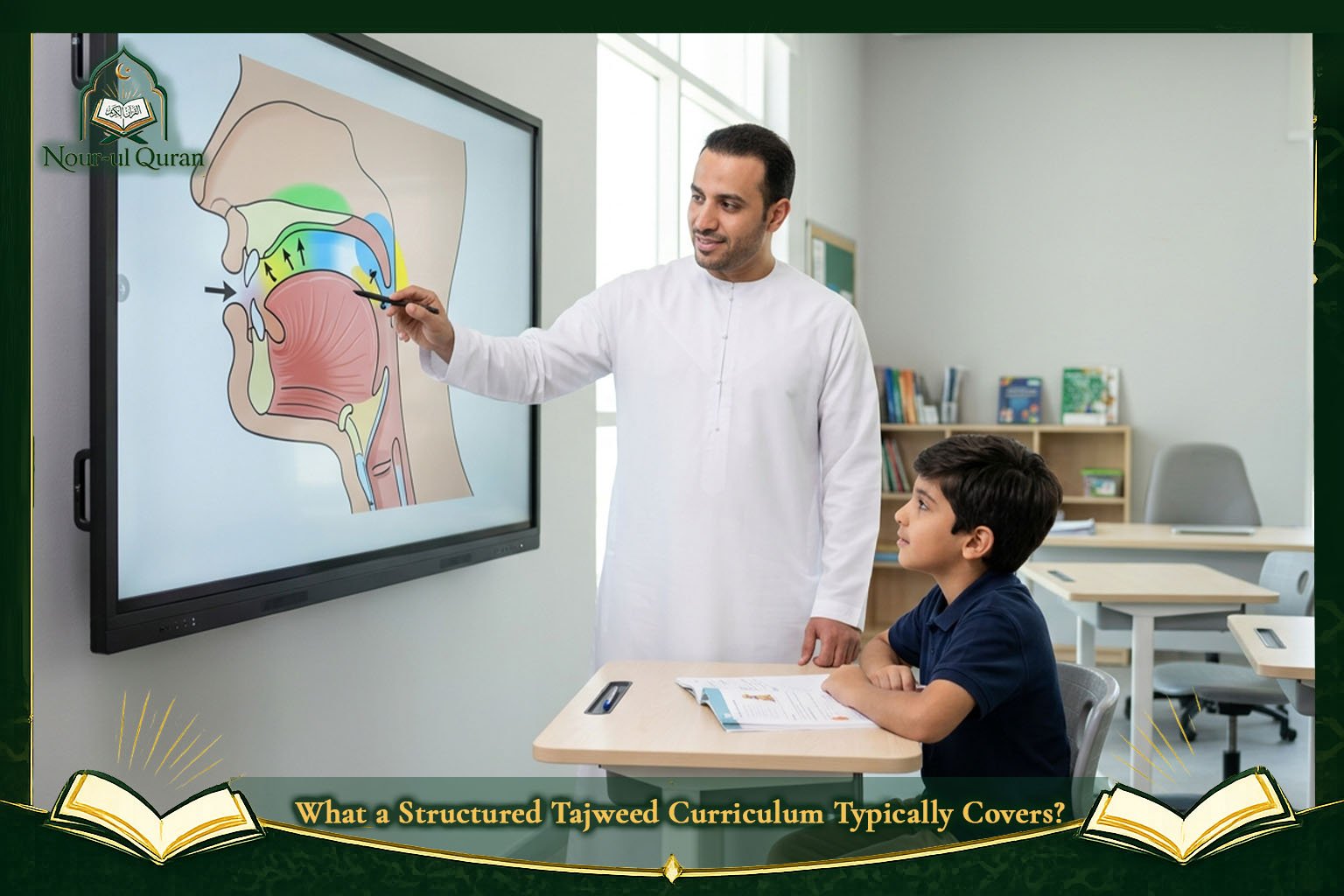
A serious Tajweed program usually moves through a fairly consistent progression, regardless of whether it's taught online or in person.
Correct articulation points (Makharij) for every letter. This is the foundation, understanding exactly where in the mouth or throat each letter is properly produced, and how to distinguish similar sounding letters from each other clearly.
Rules of Noon Sakinah and Tanween. These cover what happens when a specific letter combination occurs, including when to apply a clear pronunciation, when to merge sounds together, when to apply the nasal ghunnah sound, and when to hide the sound partially.
Rules of Meem Sakinah. A similar set of rules specifically covering a different letter combination and how it should be handled in recitation.
Rules of elongation (Madd). Covering the different types of elongation and exactly how many beats each type should be held for, which varies based on specific letter combinations and contexts within the text.
Heavy and light letters (Tafkheem and Tarqeeq). Learning which letters are always pronounced heavily, which are always light, and which change depending on context, is a substantial part of intermediate Tajweed study.
Proper stopping and starting rules (Waqf and Ibtida). Understanding where recitation can appropriately pause and where it should continue without breaking, based on the meaning and structure of the verse.
A good program doesn't rush through all of this in a few sessions. Each rule needs genuine practice and repeated correction before moving to the next, since Tajweed is fundamentally a skill built through habit, not just information absorbed by listening to an explanation once.
Tajweed for Kids vs Tajweed for Adults
The rules themselves don't change based on age, but the teaching approach usually does.
For children, Tajweed is often woven directly into early Quran reading instruction from the very beginning, through the Noorani Qaida and similar foundational materials, rather than being taught as a separate, standalone subject. This approach builds correct habits from day one, which is considerably easier than correcting incorrect habits later.
For adults, particularly those who already read Quran but never received formal Tajweed instruction, classes often function more like a targeted correction process. A good tutor identifies which specific habits need adjusting, since an adult reader typically already knows most letters and basic reading mechanics, and focuses lessons on refining pronunciation and applying rules the student may have been unknowingly skipping for years.
Both groups benefit from the same underlying content, but the pacing, starting point, and teaching style differ meaningfully based on prior reading ability and habits already in place.
What to Expect in Your First Few Sessions?
The first session or two in a good Tajweed program typically focuses on assessment. A tutor will usually ask you, or your child, to read a short passage aloud, listening carefully for specific patterns of mistakes rather than assuming a generic starting point.
From there, lessons typically address the most foundational or most frequently occurring issues first, since correcting basic articulation points before moving to more advanced rules like elongation timing generally produces better results than trying to fix everything simultaneously.
Homework usually involves short daily practice reading aloud, focusing specifically on whatever rule or habit was addressed in the most recent session, rather than lengthy general reading practice without a specific focus.
Progress in Tajweed tends to be gradual and somewhat subtle at first, small corrections here and there rather than dramatic overnight change. Over a few months of consistent practice, though, the cumulative improvement in recitation accuracy and quality becomes genuinely noticeable, both to the student themselves and to anyone listening.
Questions to Ask Before Choosing a Tajweed Program
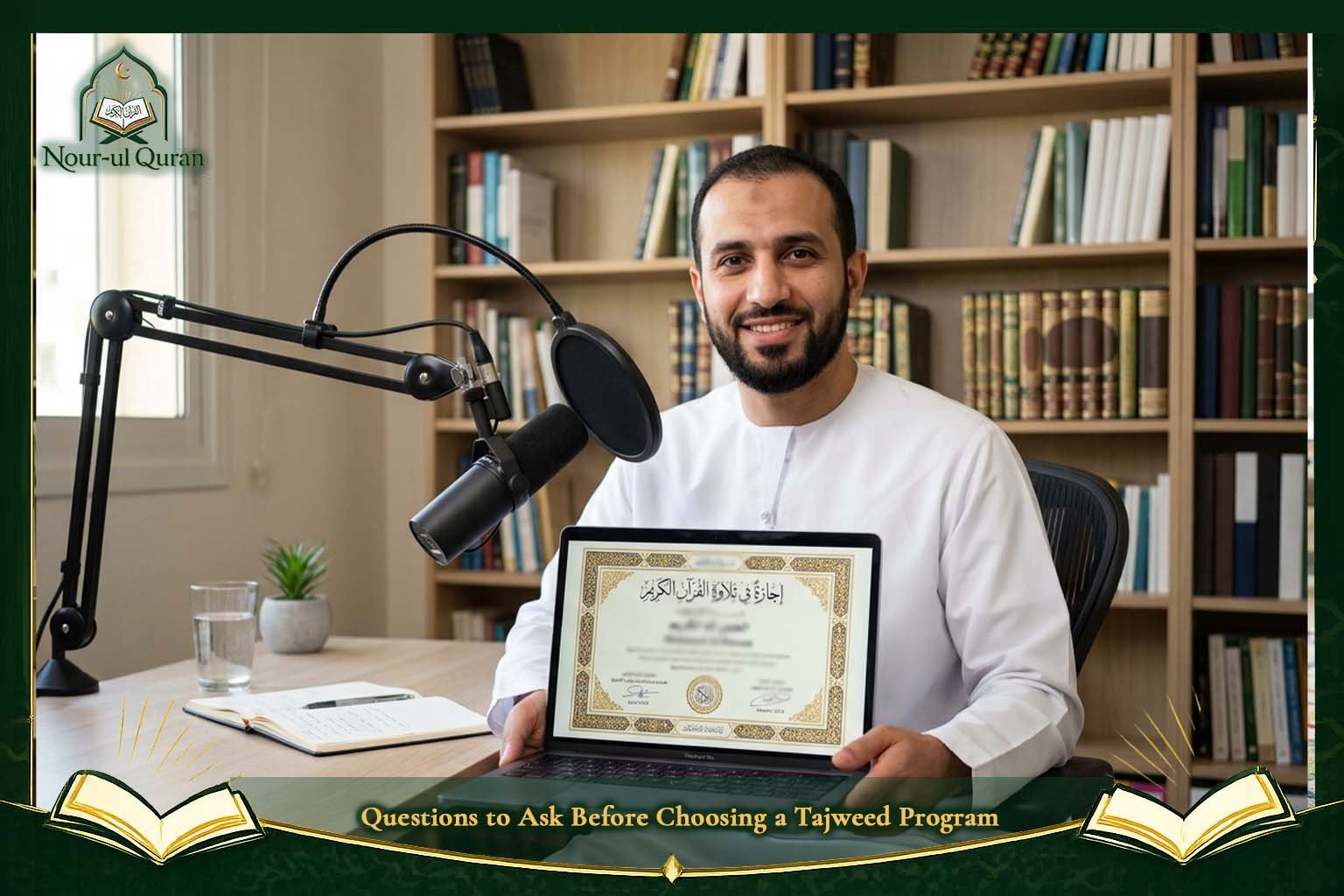
What is the tutor's own certification in Tajweed and recitation specifically? Look for Ijazah in Tajweed or Quran recitation specifically, not just general Islamic knowledge, since this reflects verified mastery of correct recitation through a recognized scholarly chain.
How is the curriculum structured, and in what order are rules taught? A serious program should be able to walk through the typical progression of rules covered, rather than teaching rules randomly as they come up in whatever passage is being read that day.
Is there room to focus specifically on habits I, or my child, already have? Especially for adult students correcting existing habits, ask whether lessons are tailored to specific individual mistakes rather than following an identical generic script for every student.
Is a trial session available? As with any subject, experiencing a real session before committing to a longer program is the clearest way to know if the teaching style and pacing genuinely suit you.
Common Challenges Students Face With Tajweed
Feeling like progress is invisible. Tajweed improvement is often gradual and subtle, which can make it feel like nothing is changing, especially compared to something like memorization where progress feels more concrete. Recording yourself reading occasionally and comparing it to earlier recordings can help make otherwise invisible progress feel more tangible.
Breaking long-held habits as an adult. Correcting a pronunciation habit that's been in place for twenty or thirty years takes more repetition than building a correct habit from scratch as a child. This is completely normal and simply requires a bit more patience and consistent practice.
Overwhelm from too many rules at once. Tajweed involves a genuinely large number of specific rules, and trying to absorb them all quickly tends to backfire. A good tutor paces this deliberately, introducing rules gradually rather than all at once.
Difficulty applying rules while reading fluently. Knowing a rule in isolation is different from applying it naturally while reading at a normal pace. This gap closes with consistent practice over time, but it's worth expecting as a normal part of the learning curve rather than a sign something is wrong.
Why do students choose Nour-ul Quran Academy for Tajweed?

At Nour-ul Quran Academy, our Tajweed instruction is built into every level of our Quran program, whether a student is a young beginner building correct habits from their very first lesson, or an adult specifically seeking to correct pronunciation habits developed over many years.
Our tutors hold genuine Ijazah in Tajweed and Quran recitation and are Al Azhar trained, meaning the rules being taught trace back through a properly verified scholarly chain rather than informal, secondhand learning. Every session is live and one on one over Zoom, allowing tutors to listen closely and correct in real time, with pacing adjusted specifically to each individual student's existing habits and starting point.
We work with children building foundational Tajweed alongside their early Quran reading, as well as adults revisiting and correcting their recitation years after initially learning to read. Classes run seven days a week across all time zones, and we send regular progress updates so you always know exactly which rules have been covered and which need continued practice.
Frequently Asked Questions
Do I need to already read Arabic before starting Tajweed classes? Basic Arabic reading ability generally helps, since Tajweed builds on top of letter recognition and reading. That said, foundational reading and early Tajweed rules can also be taught together for true beginners.
Can adults really correct pronunciation habits they've had for decades? Yes, with consistent practice and proper correction. It typically takes more repetition than building correct habits from scratch as a child, but genuine improvement is entirely achievable at any age.
How long does it take to learn Tajweed properly? This varies based on prior reading ability and consistency, but many students cover the core rules over several months to a year of regular practice, with ongoing refinement continuing naturally through consistent Quran reading afterward.
Is Tajweed only relevant for people planning to memorize the Quran? No. Correct Tajweed matters for anyone reading the Quran, regardless of whether memorization is a goal, since it reflects reciting the text as it has been authentically preserved and transmitted.
How many sessions per week are recommended for Tajweed specifically? Two to three sessions weekly tends to work well, since consistent repetition and correction are central to how Tajweed habits actually improve over time.
Final Thoughts
Online Tajweed classes fill a gap that a lot of people, both children just starting their Quran journey and adults who've been reading for years, genuinely benefit from addressing. The rules themselves have been carefully preserved for over a thousand years specifically to protect how the Quran is recited, and learning them properly, with a qualified tutor who can actually hear and correct mistakes in real time, makes a lasting difference in how someone reads and recites for the rest of their life.
Whether you're building these habits in from the very beginning or correcting years of small mistakes as an adult, consistent practice with the right teacher is what actually moves the needle here, far more than any specific timeline or milestone.
If you'd like to experience this firsthand, Nour-ul Quran Academy offers a trial class so you or your child can see exactly how Tajweed correction works in a real session before committing to a longer program.