
Islamic Studies for Kids: A Complete Guide for Parents
Every Muslim parent reaches this point eventually. Your child is old enough to start asking real questions. Why do we pray five times a day. Who was the Prophet Muhammad, peace be upon him. What happens after we die. Why do we fast in Ramadan when it's hard. And you realize that answering these questions well, in a way that actually sticks and makes sense to a child, takes more than a few improvised conversations here and there.
That's really what Islamic Studies for kids is about. It's not just religious education in the abstract sense. It's giving your child a real foundation, the kind that helps them understand who they are, why their family does what it does, and how to carry that identity confidently as they grow up, especially if they're growing up somewhere without a large Muslim community around them.
This guide covers what a proper Islamic Studies curriculum for children actually includes, how to know if a program is doing it well, and practical ways to keep your child genuinely interested rather than treating it like another dry subject to get through.
What Does Islamic Studies for Kids Actually Cover?
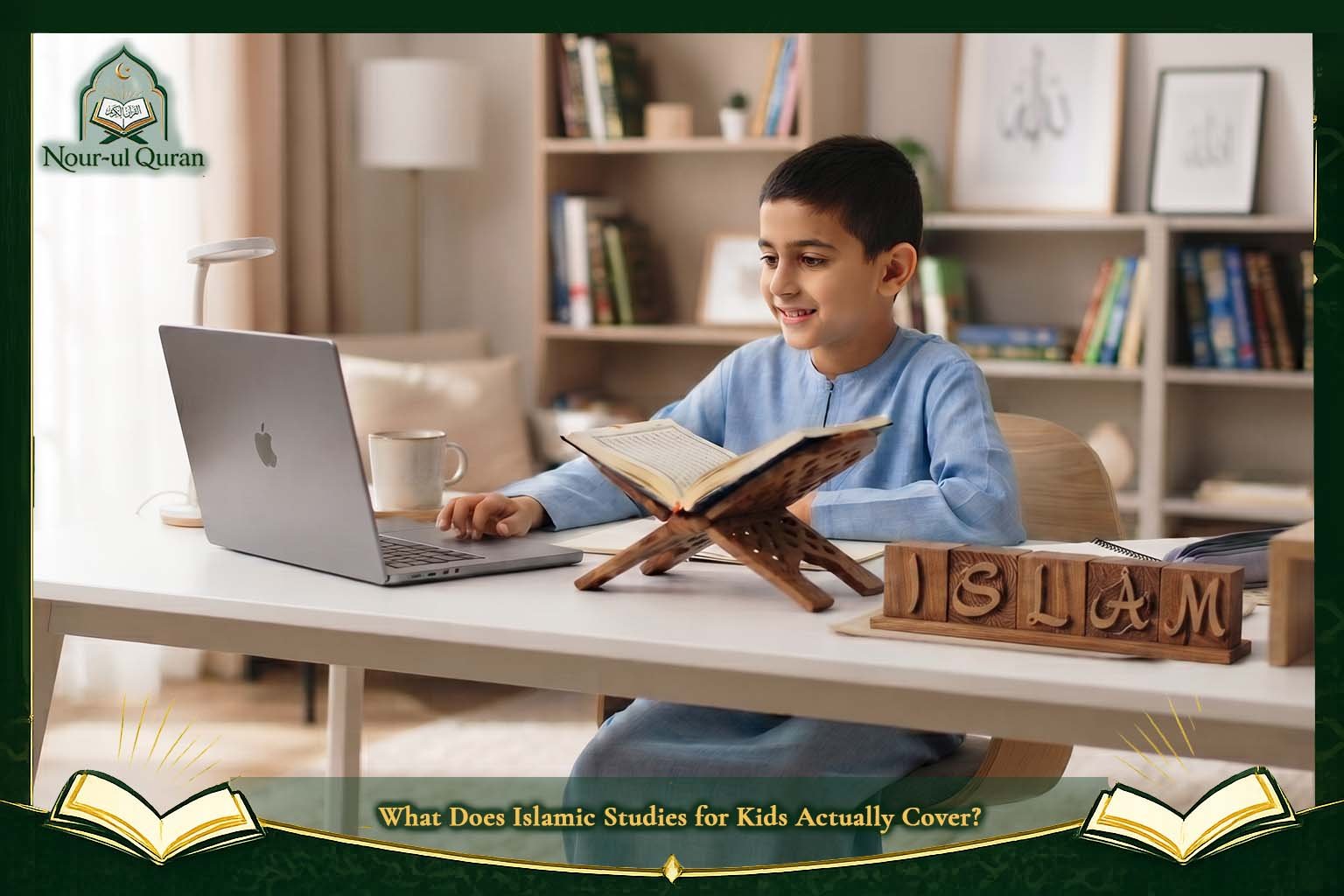
A lot of parents assume Islamic Studies is basically just Quran memorization with some extra prayers thrown in. It's actually a lot broader than that, and a well-structured program usually includes several distinct areas that build on each other over time.
Aqeedah, or the foundations of belief. This covers the core beliefs of Islam in age-appropriate terms. Belief in one God, the role of the prophets, the angels, the holy books, and the Day of Judgment. For younger kids, this is taught through simple, clear explanations and stories rather than dense theological language.
Fiqh, or the practical rulings of daily worship. This is the how-to side of things. How to perform wudu correctly, how to pray, what breaks a fast, the basics of what's permissible and what isn't in everyday situations a child actually encounters. This is often the most hands-on part of Islamic Studies, since kids learn a lot of it through practice rather than just listening.
Seerah, the life of the Prophet Muhammad, peace be upon him. Kids generally respond really well to this part, because it's told through stories rather than lectures. Learning about his childhood, his character, and key moments from his life gives children a real, relatable figure to look up to, not just an abstract historical name.
Islamic manners and character are known as Akhlaq. This covers honesty, kindness, respect toward parents, how to treat others fairly, and patience. A lot of this overlaps with general good values, but framing it specifically within an Islamic context helps children connect their everyday behavior to their faith directly.
Stories of the prophets. Beyond just the Prophet Muhammad, peace be upon him, children usually learn about other prophets mentioned in the Quran, such as Ibrahim, Musa, Yusuf, and others. These stories carry lessons about patience, honesty, and trust in God that resonate with kids in a way that direct moral lectures often don't.
A comprehensive program touches all of these areas over time, rather than focusing heavily on just one and calling it complete.
Build a Strong Islamic Foundation for Your Child
Help your child learn essential Islamic knowledge through Islamic Studies for Kids at Nour Ul Quran Academy. Our online lessons introduce young learners to important Islamic concepts, values, manners, stories, and teachings in an age-appropriate way.
With qualified teachers and personalized instruction, children can learn from home in a comfortable and supportive environment. These lessons can help make Islamic education a meaningful part of your child's routine. Enroll your child today and give them the opportunity to grow with beneficial Islamic knowledge at Nour Ul Quran Academy.
Why does Structured Islamic Studies Matter More Than Casual Conversations at Home?
A lot of well-meaning parents try to handle Islamic education purely through conversations at home, answering questions as they come up. That instinct is good, and those conversations absolutely still matter. But relying on that alone tends to leave real gaps.
For one thing, kids don't always ask about the things they most need to understand. A child might ask fifty questions about why they can't eat certain foods but never think to ask why Muslims believe in one God, simply because the second question hasn't occurred to them yet. A structured curriculum makes sure the important foundational topics actually get covered, rather than depending on a child's random curiosity to bring them up.
There's also a consistency issue. Busy family life means these conversations often happen inconsistently, a deep dive one week and then nothing for a month. A dedicated Islamic Studies class, whether in person or online, builds in the kind of regular, steady exposure that actually helps concepts stick over time.
And frankly, a lot of parents, even practicing, knowledgeable ones, aren't necessarily equipped to explain things like the differences between the pillars of Islam and the pillars of faith, or the details of what invalidates a fast, in a way that's both accurate and age-appropriate for a seven-year-old. A qualified teacher trained specifically in children's Islamic education fills that gap well.
How do Online Islamic Studies Classes Work for Kids?
For families without access to a local Islamic school or a strong weekend program nearby, online Islamic Studies classes have become a genuinely solid alternative, and honestly, for a lot of families, a preferred one even when local options do exist.
Live, One-on-One Sessions
Similar to Quran and Arabic learning, one-on-one instruction tends to work best for younger children specifically. A tutor working individually with a child can notice immediately if a concept isn't landing and adjust the explanation right there, rather than moving on because a group is ready to continue.
This also gives kids more room to ask the questions they might feel shy about in a group setting. A lot of religious questions, especially the harder ones about death, hardship, or things a child has heard from friends at school, come up more easily in a one-on-one, low-pressure setting.
Age Appropriate, Structured Curriculum
A good online program breaks Islamic Studies into levels based roughly on age and prior knowledge, rather than teaching the same material the same way to a five-year-old and a twelve-year-old. Younger children typically start with simple concepts, short Prophet stories, and basic prayer practice, while older kids move into more detailed fiqh rulings, deeper seerah study, and discussions that involve more reasoning and context.
Teachers Trained Specifically for Children
Just like with Quran and Arabic instruction, not every knowledgeable adult is naturally good at teaching young kids. Look for academies where tutors have specific experience and training in children's Islamic education, not just general Islamic knowledge. The ability to keep a seven-year-old engaged for thirty minutes while explaining something like the concept of the Day of Judgment is a specific skill, not something every knowledgeable adult automatically has.
Regular Communication With Parents
Good programs keep parents in the loop, sharing what topics were covered each week and flagging anything worth reinforcing at home. This matters especially with Islamic Studies, since a lot of the real learning happens through repetition and lived example at home, not just during the class itself.
Combining Islamic Studies With Quran and Arabic Learning
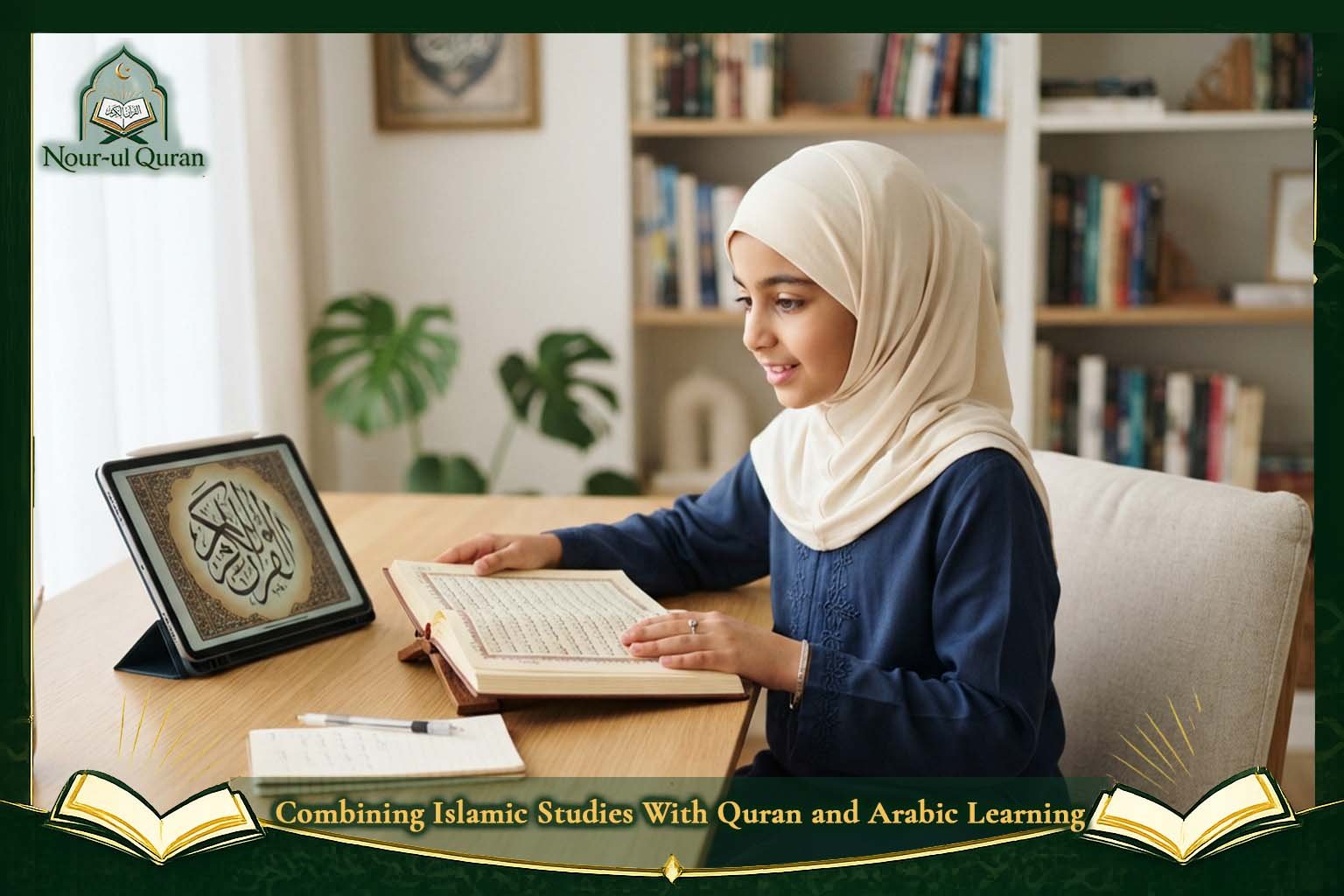
For a lot of families, Islamic Studies works best when it's not treated as a completely separate subject from Quran and Arabic learning, but rather as something that reinforces the same foundation from a different angle.
A child memorizing a verse about patience in their Quran class, for example, gets a lot more out of it if they've also learned the story of a prophet who demonstrated that same patience in their Islamic Studies lessons. The two reinforce each other, and children start to see the Quran, the seerah, and daily practice as one connected picture rather than three unrelated school subjects.
This is part of why a lot of academies, ours included, structure their programs so a child's Quran memorization, Arabic language learning, and Islamic Studies classes complement rather than duplicate each other. It also just makes scheduling simpler for parents, since everything runs through one consistent platform and one set of tutors familiar with your child.
What to Expect in the First Few Weeks?
If your child is new to structured Islamic Studies classes, the first few sessions usually focus on getting a sense of where they currently stand. A good tutor will ask simple, low pressure questions to understand what your child already knows, what they've picked up from home or previous informal learning, and where the real gaps are.
From there, lessons typically follow a predictable weekly rhythm. A quick review of the previous topic, introduction of new material through stories or simple explanations rather than lectures, some interactive discussion where the child is encouraged to ask questions, and a light wrap-up connecting the lesson to something practical they can apply that week.
For younger children specifically, expect a lot of storytelling. Good teachers understand that a five-year-old retains far more from a well-told story about Prophet Yusuf than from a direct explanation of abstract concepts, and structure lessons accordingly.
Homework, if assigned at all in the early stages, tends to be light. Maybe a simple question to think about and discuss with parents, or a small practical task like practicing a specific part of wudu. Overloading young children with heavy homework in this subject specifically tends to make it feel like a chore rather than something meaningful.
Questions to Ask Before Choosing a Program
A short conversation with any academy before enrolling can save a lot of frustration later. Here's what's worth asking directly.
What does the curriculum actually cover, and in what order? A serious program should be able to describe clearly what topics get covered over the coming months, not just say "we cover everything" vaguely.
How is content adjusted for different ages? Ask specifically how a lesson for a five-year-old differs from one for a ten-year-old on the same general topic.
What's the teacher's background, specifically in children's Islamic education? General Islamic knowledge is necessary but not sufficient. Ask about specific experience teaching kids, not just adults or general audiences.
Is there room for my child to ask questions, including harder ones? Kids sometimes come up with genuinely tough questions about death, hardship, or things they've heard elsewhere that conflict with what they're learning. Ask how tutors are trained to handle these moments.
Is a trial class available? As with any subject, trying a class firsthand before committing to a longer plan is the clearest way to know if the teaching style and pacing actually suit your child.
Common Challenges Parents Face
Balancing depth with a child's attention span. Some topics in Islamic Studies are genuinely deep, and it's easy for a well-meaning explanation to go over a young child's head. Good tutors break complex ideas into small, age-appropriate pieces rather than trying to cover everything in one sitting.
Handling hard questions. Kids sometimes ask things that catch parents off guard. Why did this bad thing happen if God is in control? Why do some people not believe? These are normal, healthy questions, and a good program handles them calmly and honestly rather than deflecting, in a way that matches the child's age and maturity.
Keeping consistency at home. A weekly class alone won't build a strong foundation on its own. It works best paired with small, consistent reinforcement at home, a short conversation here, a practice moment there, rather than treating the class as the only source of Islamic learning.
Avoiding a purely rules-based approach. It's easy for Islamic Studies to feel like a long list of dos and don'ts if it's not balanced with the meaning and wisdom behind those rules. Good teachers explain the why, not just the what, which helps kids actually internalize things rather than just memorize a checklist.
Practical Ways to Reinforce Learning at Home
A handful of simple habits can make a real difference in how much actually sticks.
Tell the stories yourself sometimes, even a simplified version. Repetition from more than one source, the tutor and a parent, helps a story or lesson stay in a child's memory much longer.
Connect lessons to daily moments naturally. If your child learns about honesty in their Islamic Studies class, gently reference it later that week when a relevant real-life situation comes up, without turning it into a lecture.
Let kids ask questions without shutting them down, even the uncomfortable ones. A child who feels safe asking hard questions at home is far more likely to keep engaging honestly with their faith as they get older, rather than quietly disengaging.
Model the behavior yourself. Kids absorb far more from watching how their parents actually practice than from any single lesson. Consistency in your own small daily practices reinforces the classroom content more than almost anything else.
Why do families choose Nour-ul Quran Academy for Islamic Studies?
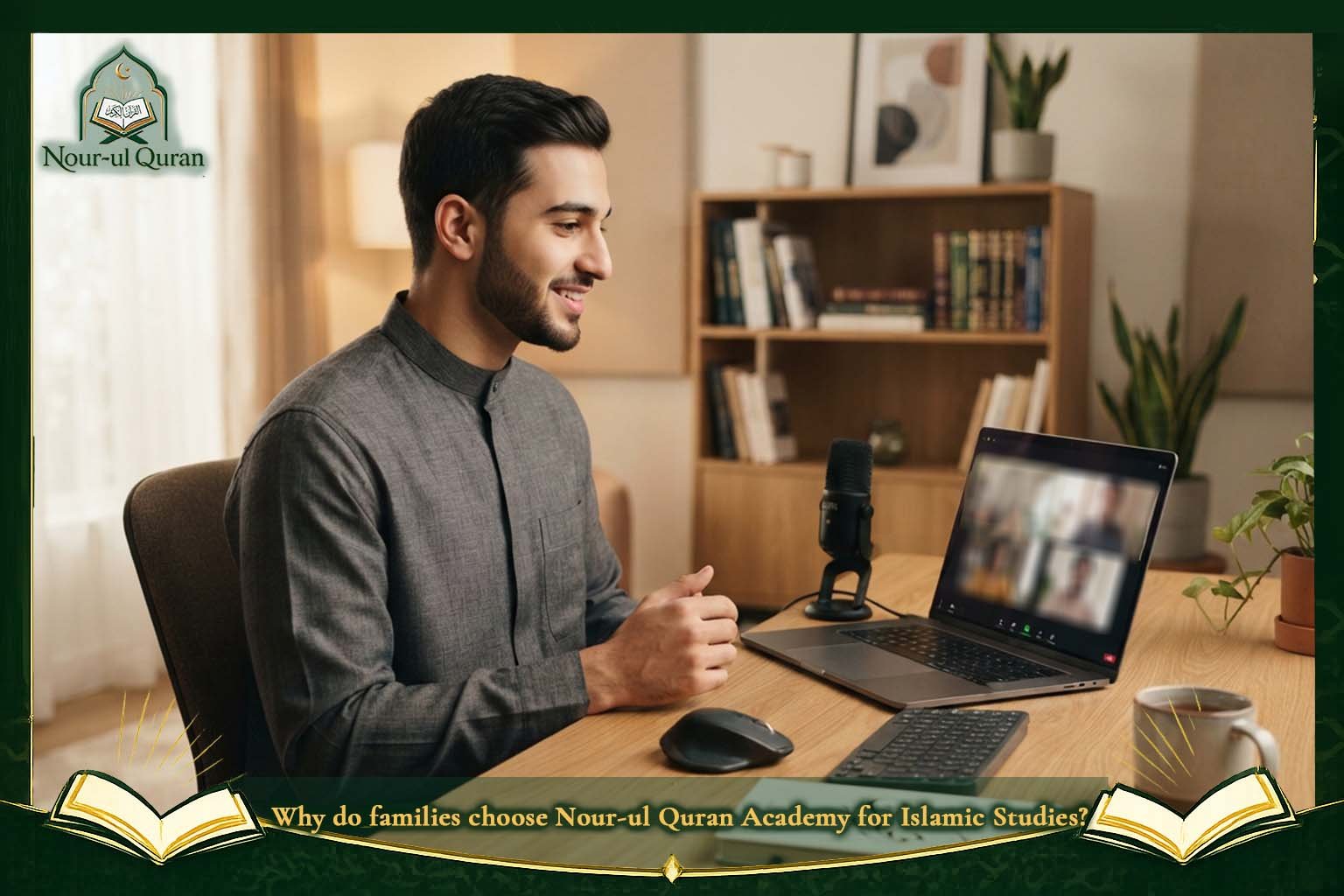
At Nour-ul Quran Academy, our Islamic Studies program for kids is built around exactly this kind of balanced, age-appropriate approach. Our tutors are trained specifically to work with children living in the USA, UK, Canada, Europe, and Australia and understand the particular challenges of raising a strong Islamic identity outside a Muslim-majority environment.
Classes are live and one-on-one over Zoom, so your child gets full attention and space to ask their own questions, rather than sitting through a fixed lesson that doesn't leave room for that. We run classes seven days a week across all time zones, so scheduling fits around your family's life rather than the other way around.
We also send regular updates so you know exactly what's being covered and can reinforce it naturally at home, and if a tutor isn't quite the right personality fit for your child, switching is simple and quick.
Whether your child is just starting to learn the basics of prayer and simple Prophet stories, or ready for deeper discussions around fiqh and seerah, our Islamic Studies classes are structured to grow with them, alongside their Quran and Arabic learning, if you choose to combine the subjects.
Frequently Asked Questions
At what age should a child start Islamic Studies classes? Most academies, including ours, welcome children from around age four or five, with content and pacing adjusted heavily based on age and comprehension level.
Are Islamic Studies the same as Quran memorization? No. Islamic Studies covers a broader range of topics, including beliefs, practical worship, the life of the Prophet Muhammad, peace be upon him, and Islamic manners, while Quran classes focus specifically on reading, Tajweed, and memorization. Many families choose to combine both.
How many classes per week are recommended? One to two sessions weekly is usually enough for steady progress in Islamic Studies specifically, though this can be adjusted based on your child's interest and schedule.
What if my child asks a question the tutor can't fully answer in the moment? A good tutor will acknowledge the question honestly and follow up with a proper answer later rather than guessing, and will often encourage the parent to continue the conversation at home as well.
Can Islamic Studies be combined with Quran and Arabic classes? Yes, and for a lot of families, this works particularly well, since the subjects reinforce each other and it simplifies scheduling to work with the same academy across all three areas.
Final Thoughts
Islamic Studies for kids is really about giving children a foundation they can build on for the rest of their lives, not just information to memorize for the moment. Done well, it helps kids understand their identity clearly and confidently, especially valuable for those growing up away from a large Muslim community.
The key, as with any subject, is choosing a program that's structured, age-appropriate, and taught by someone genuinely trained to work with children rather than just knowledgeable in the subject matter generally. Try a trial class, ask real questions about the curriculum, and pay attention to how your child responds, since genuine engagement matters far more than any impressive-sounding syllabus.
If you'd like to see how this works in practice, Nour-ul Quran Academy offers a trial class so your child can experience a real lesson firsthand before you commit to anything further.