
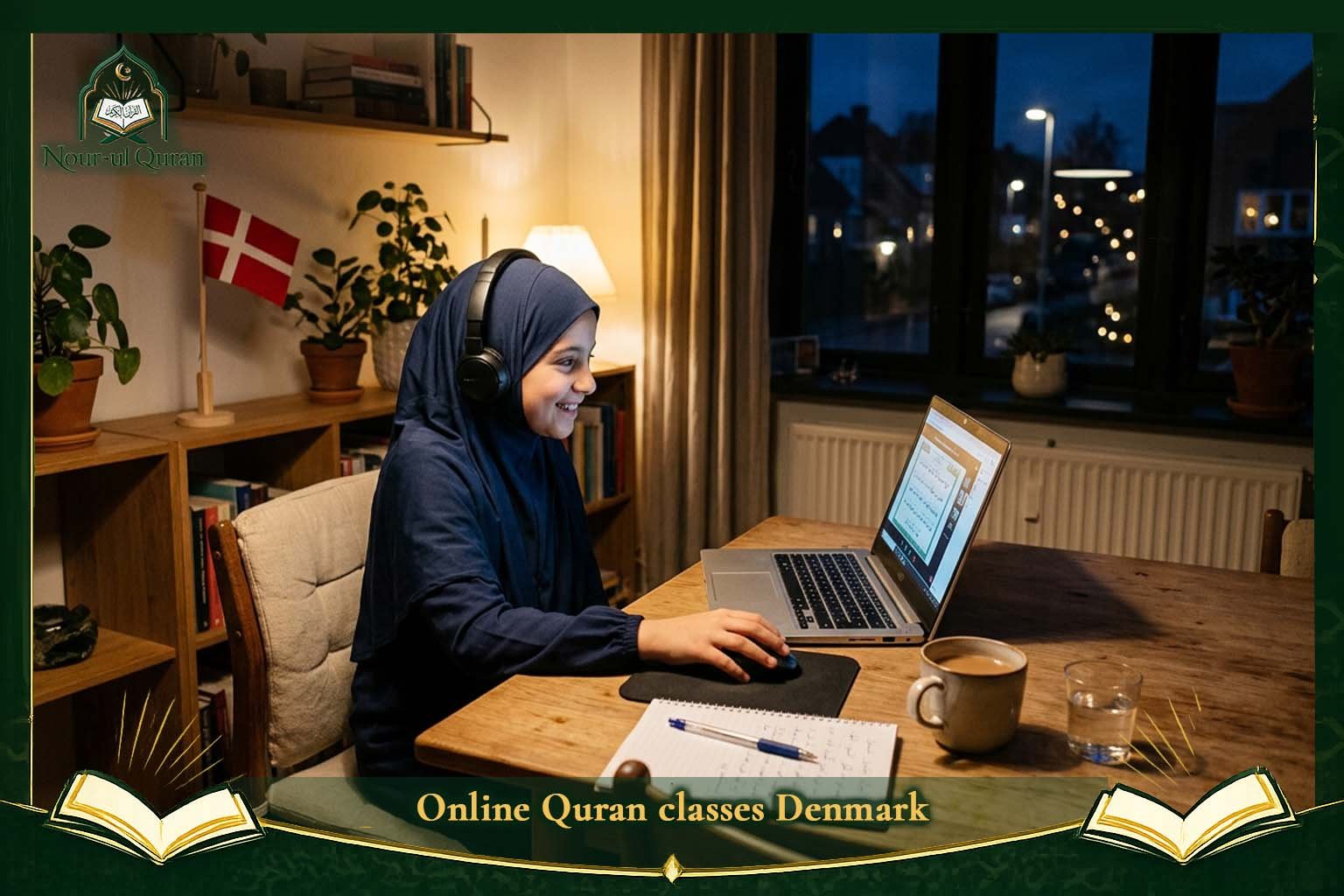
Picture this. It's a Tuesday evening in Aarhus, or Odense, or a smaller town somewhere in Jutland. Your child has just finished homework from school, dinner is barely cleared off the table, and now you're supposed to get them out the door, in the dark, for a Quran class that starts in fifteen minutes. Half the time you make it. Half the time you don't, and the guilt of another missed week quietly builds up.
If that sounds familiar, you're far from alone. It's one of the most common reasons Danish Muslim families have started looking seriously at online Quran classes Denmark wide over the past few years, not as a lesser substitute for something better, but often as the more realistic, more sustainable option for how their family actually lives.
Let's go through what's actually driving this shift, how it works in practice for a country with Denmark's specific rhythm and geography, and what to genuinely look for before choosing a program.
Denmark's Muslim Community, and Why Access Varies So Much
Denmark's Muslim population sits at a meaningful size nationally, concentrated heavily around Copenhagen, with additional communities in cities like Aarhus, Odense, and Aalborg. Outside those areas, though, options for structured children's Quran education thin out considerably. A family in a smaller Jutland town might find themselves with essentially no local option beyond whatever a small, informal community group can offer, which, while often well intentioned, rarely comes close to a properly structured curriculum taught by a qualified instructor.
Even within Copenhagen itself, demand for good children's Quran programs frequently outpaces supply, leaving some families on waiting lists or settling for large group classes where individual attention is genuinely limited.
Five Things Worth Knowing Before You Start
Rather than a long theoretical explanation, here's what actually matters in practice if you're a Danish family considering this route.
1. The time difference works in your favor. Egypt sits roughly one hour ahead of Denmark for most of the year. This is a small enough gap that most established academies, including those built specifically for international students, can offer slots that land comfortably within a Danish family's after school and evening window. It's still worth asking any specific program exactly which hours they cover, rather than assuming.
2. One on one really does mean something different for Tajweed correction. If you've ever sat in on a group class and noticed your child's specific mispronunciation never actually got addressed because the teacher was managing eight other kids at once, you already understand why individual sessions matter so much here. A tutor working with just your child can catch and fix a mistake the moment it happens.
3. Not every tutor is equally suited to teaching kids raised outside Arabic speaking countries. This one gets overlooked constantly. A teacher who has only ever taught children fully immersed in Arabic daily life approaches lessons differently than one who regularly works with kids whose primary language is Danish and who hear Arabic maybe once or twice a week during lessons. Ask directly about this experience before committing.
4. Danish school holidays don't line up neatly with generic scheduling assumptions. Denmark's school calendar, with its efterårsferie, vinterferie, and other breaks spread through the year, doesn't match a lot of programs' default assumptions about term time. A good academy handles rescheduling around this without friction. A rigid one doesn't.
5. Combining subjects tends to work better than juggling separate programs. If your goals include Quran reading, Arabic language, and general Islamic knowledge, working with one consistent team across all three, rather than three unrelated providers, considerably simplifies both scheduling and how well the subjects reinforce each other for your child.
What This Actually Looks Like Week to Week
A typical setup for a Danish family usually involves two or three sessions a week, each thirty minutes to an hour depending on age and focus area, scheduled sometime between the end of the school day and early evening. The tutor works one on one with your child over video, correcting pronunciation, building reading skills, or reviewing memorized material depending on what stage your child is at.
Parents typically receive some form of weekly update, so you're not left guessing whether real progress is happening or whether your child is simply repeating the same lesson content week after week without moving forward.
The Subjects Worth Considering
Depending on where your child is starting from and what your family's goals look like, a few different areas tend to come up.
If your child has never learned to read Arabic script at all, starting with online Quran classes for beginners makes the most sense, building letter recognition and basic reading from the ground up.
If pronunciation has already become a bit of a bad habit, picked up informally without correction, online Tajweed classes focus specifically on identifying and fixing those patterns.
For families with memorization as a longer term goal, online Quran memorization classes follow the traditional structured approach used in Hifz programs everywhere, adapted for a realistic weekly pace.
Since Arabic exposure tends to be genuinely limited for kids growing up fully in a Danish speaking environment, a lot of families also add online Arabic classes for kids, which makes both Quran reading and memorization considerably more meaningful.
And for the broader picture beyond just reading and reciting, Islamic Studies for kids covers belief, worship, and character in a way that helps children understand the why behind what they're learning, while Islamic Studies for adultsis worth considering if you're looking to strengthen your own foundation at the same time.
Questions Danish Parents Tend to Ask
Is it actually worth it if we already have some access to a local class, even a limited one? This depends on your specific situation, and it's genuinely not always an either or decision. Our comparison of online Quran academy vs local mosque covers this tradeoff honestly, and plenty of families end up using both in different ways.
How do we know a program is actually structured rather than just improvised session to session? This is worth asking directly, and we've laid out the specific questions worth putting to any academy in our guide on how to choose an online Quran academy.
Our week is already packed. Is this realistic for us? It's one of the most common concerns, and honestly a fair one. Our piece on online Quran learning for busy families addresses this directly, including how shorter, more frequent sessions tend to fit better than trying to carve out one long weekly block.
What are we actually gaining compared to just continuing informally at home? Structure, consistency, and correction from someone properly trained, mainly. Our overview of the benefits of joining an online Quran academy and our roundup of best online Quran learning methods go into this in more depth.
What age should we start? Most programs, including ours, work with children from around age four or five, adjusting pace and session length for what's realistic at that age.
Before You Commit
A short list worth going through with any academy you're seriously considering. Confirm the teacher's actual qualifications, ideally Al Azhar trained with real Ijazah where relevant. Ask specifically whether they've taught children raised outside Arabic speaking countries before, since Denmark's specific context genuinely matters here. Check what happens if a session needs to be rescheduled around a Danish school holiday. And ask about a trial session, since watching how your specific child responds to a specific tutor tells you more than any amount of reading a website ever will.
Where to Go From Here
If Tuesday evening scramble scenario from the start of this article sounds a bit too close to home, it might be worth simply trying a different approach for a few weeks and seeing how it goes. Nour-ul Quran Academy offers a trial class specifically so Danish families can see what a real session looks like, at a time that actually fits your evening, before deciding whether to commit to anything longer term.