
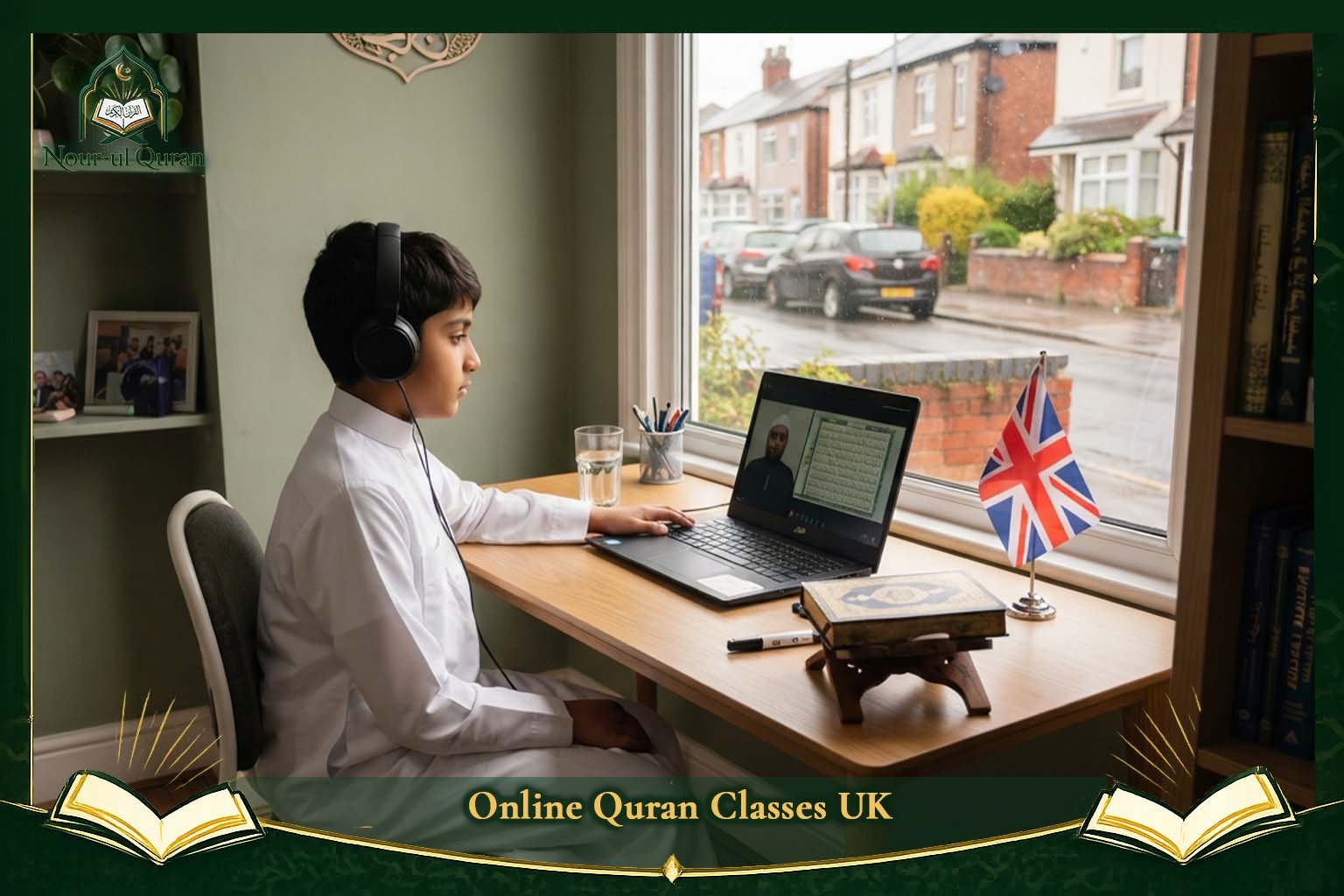
Britain's Muslim community is spread out in a way that doesn't always match up with where good Quran education is actually available. Cities like Birmingham, London, Bradford, and Manchester have long established mosques with strong children's programs. But plenty of families live in towns and smaller cities across England, Scotland, and Wales where the nearest structured Quran class might mean a long drive, an inconvenient evening slot, or simply nothing suitable for a young child at all.
This is exactly why online Quran classes UK wide have grown so much over the past several years. Instead of being limited to whatever happens to exist within a reasonable drive, families anywhere in the UK can now access properly qualified, experienced Quran teachers, the same quality of instruction whether you live in Tower Hamlets or a small village in Yorkshire.
This guide walks through why online classes work particularly well for UK based families, how scheduling actually plays out with the time difference, what genuinely matters when choosing a program, and how to get started with confidence.
Why UK Families Are Increasingly Choosing Online Quran Classes?
A few specific reasons come up again and again when British Muslim parents explain why they moved toward online learning rather than sticking exclusively with local options.
Uneven access depending on where you actually live. The UK's Muslim population, now well over three million according to recent census figures, is concentrated heavily in certain cities and regions. Families in those areas often have decent local options. Families elsewhere, in smaller towns or areas with a much smaller Muslim community, frequently don't. Online classes remove this geographic lottery entirely.
Weekend madrassahs that are stretched thin. A lot of UK mosques run weekend or after school Quran classes, and many do genuinely good work. But class sizes are sometimes large, with one teacher managing a room full of children at different levels, which naturally limits how much individual correction and pacing any single child receives. One on one online sessions solve this directly by giving a tutor's full attention to just one student throughout the entire lesson.
British family schedules that leave little room for extra travel. Between school runs, after school clubs, and weekend commitments, adding a physical commute to and from a mosque class on top of an already full week is genuinely difficult for a lot of families. Removing that travel time often makes the real difference between a Quran education routine that actually sticks and one that quietly falls apart after a term or two.
Wanting a program that understands growing up Muslim in Britain specifically. A child growing up in the UK navigates a particular set of circumstances, being one of relatively few Muslim kids in some schools, limited daily Arabic exposure, a school calendar and social rhythm quite different from a Muslim majority country. A good online program, particularly one with tutors experienced teaching students abroad, understands this context rather than assuming background familiarity a British born child might not have.
How Scheduling and the Time Difference Actually Work?
This is one of the first practical questions most UK parents ask, and it deserves a straightforward answer rather than vague reassurance.
Most established online Quran academies, including programs based in Egypt, run their teaching hours across a wide window specifically to cover multiple international time zones, the UK included. Egypt sits roughly two hours ahead of the UK for most of the year, which in practice means tutors are often available during hours that line up comfortably with a British family's after school and evening routine, typically anywhere from mid afternoon through to fairly late evening UK time.
In real terms, this usually means a family in the UK can find a slot right after school, say around 4 or 5 PM, or later in the evening if that suits a particular household's routine better. The key thing to confirm with any academy is how many actual time slots they offer across a full day, not just one or two fixed options, and how straightforward it is to adjust timing if your family's schedule shifts, say when the clocks change between BST and GMT, or during school holidays.
What Actually Matters When Choosing a Program in the UK?
Beyond the general things worth checking with any Quran program, a few points are particularly relevant for families based in Britain specifically.
Tutors With Real Experience Teaching Students Abroad
There's a meaningful difference between a teacher who has only worked with students physically present in an Arabic speaking classroom, and one who regularly teaches children growing up in the UK, understands limited daily Arabic exposure at home, and can relate lessons to a child's actual British upbringing. This experience genuinely shapes how effectively a tutor communicates and holds a young student's attention.
A Clear, Structured Curriculum Rather Than Loosely Improvised Sessions
With a limited number of weekly hours available for Quran study, it matters enormously that each session is building toward something specific. This is exactly the kind of question worth asking directly before committing, and it's covered in detail in our piece on how to choose an online Quran academy, which walks through the specific questions worth putting to any program you're considering.
Genuine Flexibility Around British School Terms
UK school calendars involve inset days, half terms, and holidays spread differently than in many other countries. A program with easy, hassle free rescheduling saves a lot of frustration compared with rigid, hard to shift booking systems.
Weighing Online Learning Against Local Mosque Options
Plenty of UK families already have some access to a local mosque or madrassah and wonder whether it's worth adding or switching to an online option instead. This is a genuinely personal decision, and we've laid out an honest, balanced comparison of both paths in our piece on online Quran academy vs local mosque, covering where each tends to work better depending on your family's specific circumstances.
What a Comprehensive Online Quran Program Typically Covers?
A well rounded program for UK families usually spans several connected areas, often coordinated by the same tutor or teaching team so a child's overall learning feels joined up rather than split across disconnected subjects.
Quran reading with correct pronunciation built in from day one. For children just starting out, correct Tajweed habits get woven into reading instruction from the very first lesson rather than added on separately later. If your child is starting completely from scratch, our detailed breakdown of online Quran classes for beginners covers exactly what that early stage looks like in practice.
Structured Quran memorization for families pursuing Hifz. A lot of British Muslim families specifically want their children to memorize the shorter, commonly recited chapters, even without necessarily aiming for complete memorization of the Quran. Our guide to online Quran memorization classes covers exactly how this traditional process works and what realistic timelines actually look like.
Arabic language learning, since many British Muslim children grow up with limited daily exposure to the language. Understanding basic Arabic makes both reading and memorization considerably more meaningful and easier to retain. This connection is explored fully in our guide to online Arabic classes for kids.
Focused Tajweed correction, particularly useful for children who already read somewhat but never received formal correction. This is common among kids who've picked up informal reading ability at home before starting structured lessons. Our dedicated guide to online Tajweed classes breaks this down clearly.
Islamic Studies covering belief, worship, and the life of the Prophet Muhammad, peace be upon him. For children growing up as part of a religious minority in Britain, understanding the reasoning behind Islamic practice, not just the mechanics of it, matters enormously for building genuine, lasting confidence in their identity. Our guide to Islamic Studies for kids covers this in real depth, and for parents wanting to strengthen their own foundation alongside their children, our guide to Islamic Studies for adults covers that path too.
A lot of families choose to combine two or three of these subjects together, since they naturally reinforce each other and simplify scheduling considerably compared with juggling entirely separate programs.
Real Challenges British Muslim Families Navigate
Fitting Quran education around an already packed school week. This is one of the most consistent concerns UK parents raise, and it's genuinely worth taking seriously rather than brushing aside. Shorter, more frequent sessions, two or three times a week rather than one long session, tend to fit more naturally into a British family's existing routine, and this exact challenge is addressed directly in our guide to online Quran learning for busy families.
Helping children feel confident navigating a dual identity. Plenty of Muslim kids in the UK are the only Muslim child, or one of very few, in their class or school. A strong Quran and Islamic Studies foundation does more than build recitation skill, it genuinely helps build pride and confidence in a child's identity, which matters just as much as the technical learning itself.
Making limited weekly hours count. Without the kind of daily, ambient Arabic and Quran exposure a child might have growing up in a Muslim majority country, the quality and structure of the time that is available becomes even more important. This is a big part of why choosing a properly qualified, genuinely experienced tutor makes such a real difference for UK based children specifically.
Weighing the tradeoffs of online learning honestly. It's worth understanding both the real benefits and the genuine tradeoffs before committing to any program. Our roundup of the benefits of joining an online Quran academy and our overview of best online Quran learning methods both cover this in more detail, helping you weigh what actually matters for your specific family situation.
A Quick Checklist Before Choosing a Program
Confirm the tutor's actual qualifications directly, ideally Al Azhar trained with formal Ijazah where relevant, rather than accepting vague descriptions of general experience. Ask specifically whether the tutor has experience teaching children growing up outside Arabic speaking countries, since this context genuinely shapes how effectively they teach.
Check exactly how many scheduling slots are available across the day relative to UK time, rather than just one or two fixed options. Confirm the rescheduling policy given how UK school terms and half terms can shift a family's routine throughout the year. And take advantage of a trial class before committing to anything longer term, since watching how a specific tutor interacts with your child is genuinely the clearest way to know if the fit is right.
Frequently Asked Questions
Are online Quran classes genuinely effective for children growing up in the UK? Yes. Many British Muslim children build strong reading, memorization, and Islamic Studies foundations entirely through online classes, particularly when paired with a bit of consistent reinforcement at home.
How does scheduling actually work given the time difference? Established academies typically offer teaching hours across a wide window specifically to accommodate UK families, and since Egypt sits only around two hours ahead for most of the year, finding a slot that fits after school or in the evening is usually realistic rather than a real obstacle.
Should we choose online classes instead of our local mosque program? It depends entirely on your specific circumstances. Local mosque programs offer valuable community connection, while online classes often provide more individualized attention and considerably more scheduling flexibility. Many UK families end up combining both rather than choosing one exclusively.
What age is appropriate to start online Quran classes? Most programs, including ours, welcome children starting from around age four or five, with lessons and pacing specifically adjusted for that age group.
Can we combine Quran, Arabic, and Islamic Studies classes into one program? Yes, and for a lot of UK families this works particularly well, since the subjects reinforce each other naturally and it considerably simplifies scheduling to work with one consistent academy and familiar team of tutors.
Final Thoughts
For Muslim families across the United Kingdom, online Quran classes have become a genuinely reliable way to give children a proper, lasting foundation in the Quran, regardless of which city, town, or village they call home. The key is choosing a program built specifically with this kind of family in mind, one with real scheduling flexibility around UK hours, teachers genuinely experienced working with children raised outside Arabic speaking countries, and a curriculum structured enough to make every limited weekly hour genuinely count.
If you'd like to see this in practice, Nour-ul Quran Academy offers a trial class so your family can experience a real session firsthand, at a time that actually suits your schedule, before committing to anything further.