
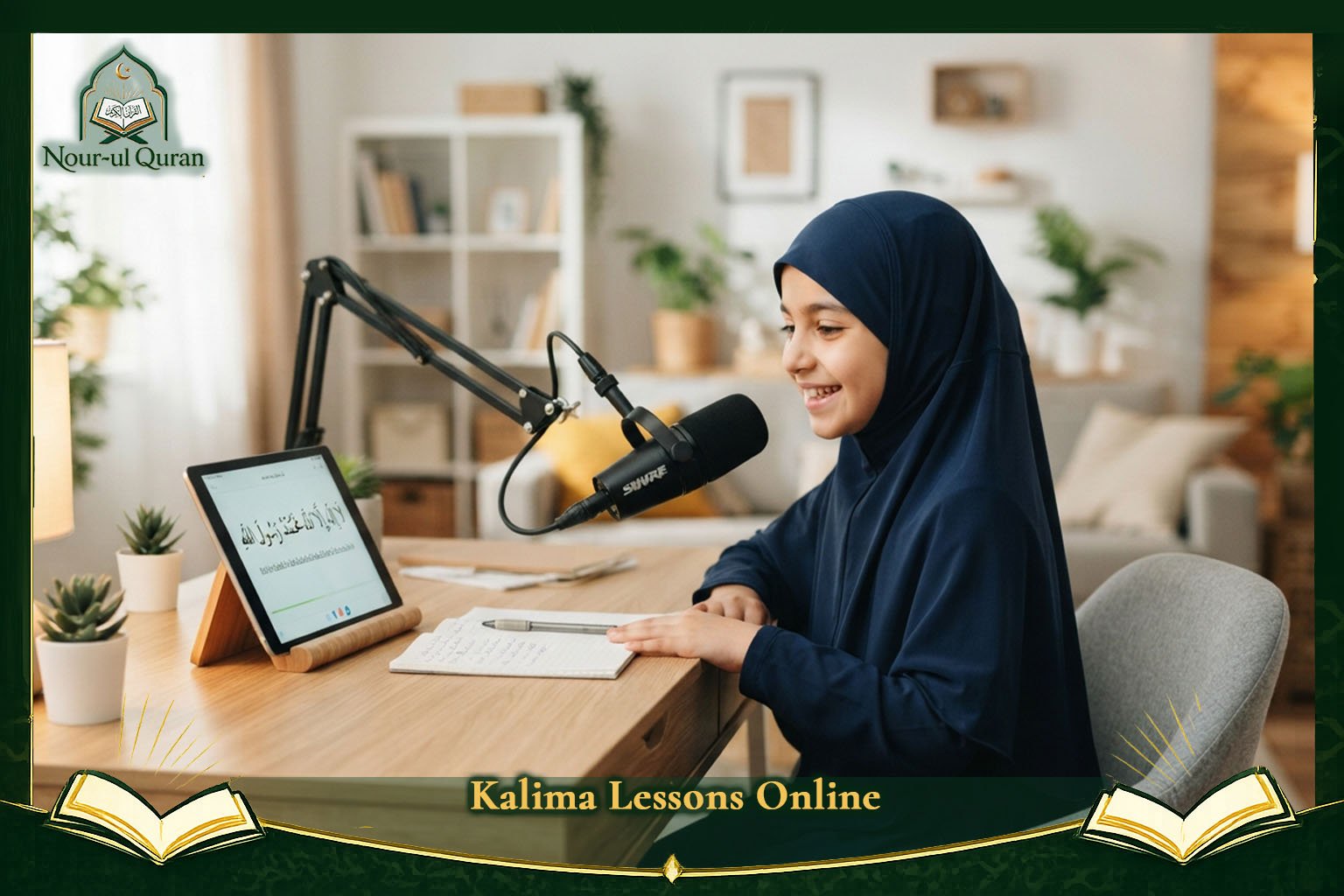
Kalima lessons online give both children and adults a structured way to learn the six fundamental declarations of Islamic faith with correct pronunciation and genuine understanding. Many Muslims memorize these declarations early in life but never learn their precise meaning or proper Arabic pronunciation.
At Nour ul Quran Academy, tutors teach all six kalimas step by step, connecting memorization with real comprehension. This article explains what these lessons cover, how sessions are structured for different ages, and who benefits most from dedicated instruction. It also addresses common questions families ask before enrolling.
What the Six Kalimas Actually Are?

The six kalimas represent foundational declarations covering faith, purity, and core Islamic belief, memorized traditionally by Muslims worldwide. Each kalima carries specific wording and meaning, building progressively on concepts introduced in the ones before it.
Many children learn the first kalima quite young, with later ones introduced gradually as comprehension develops. Understanding the specific content of each kalima matters as much as memorizing its exact wording correctly.
Start Your Islamic Learning Journey Today
Every strong Islamic education begins with learning the fundamentals. Kalima Lessons Online at Nour Ul Quran Academy give students a convenient way to learn essential Kalimas with qualified tutors from the comfort of home.
Our lessons focus on correct pronunciation, memorization, understanding, and regular practice to help learners build confidence. Suitable for children and beginners, the classes provide a supportive path toward stronger Islamic knowledge. Register today with Nour Ul Quran Academy and take the first step toward learning the Kalimas correctly and confidently.

Why Correct Pronunciation Matters in Kalima Lessons?
Small pronunciation errors in Arabic can occasionally shift a word's meaning in ways learners rarely notice on their own. Structured lessons address this directly, since a tutor listens closely and corrects errors before they become permanent habits.
Many adults carry mispronunciations from childhood simply because no one ever pointed them out directly. Correcting these habits, even later in life, genuinely improves the quality and accuracy of recitation going forward.
- Correct Arabic pronunciation for each of the six kalimas
- Clear English explanation of meaning behind each declaration
- Gradual progression matched to a student's comprehension level
- Direct correction of habits picked up without formal instruction
How Sessions Are Structured for Different Ages?
Teaching Young Children: Young children learn through repetition, simple explanation, and patient correction spread across many short sessions. The first kalima typically comes first, with later ones introduced only once earlier ones feel genuinely secure.
Teaching Adults and Reverts: Adults, including reverts building foundational knowledge from scratch, often move through material faster with more detailed explanation. Sessions for this group include more discussion around meaning and historical context alongside memorization.
How Kalima Lessons Fit Into Broader Islamic Education?
These lessons pair naturally with other foundational subjects, including basic Islamic studies and Noorani Qaida instruction. Many families begin with kalima lessons before moving into structured Quran reading, treating this as a genuine starting point.
Understanding these core declarations early gives children a foundation that later Islamic studies content builds upon directly. This sequencing helps ensure concepts introduced later make sense within a framework a student already understands.
Common Challenges Students Face
Some children struggle initially with distinguishing similar-sounding phrases across different kalimas, especially early in memorization. Similarly, adults sometimes find certain phrases challenging, particularly when unlearning a previously incorrect pronunciation practiced for years.
Instead of rushing forward, tutors address these challenges through repeated, patient practice rather than moving to the next kalima prematurely. Consequently, most students overcome these specific challenges within a few dedicated sessions once identified clearly.
How Tutors Assess Progress in Kalima Lessons?
Progress gets measured through a student's ability to recite each kalima accurately and explain its basic meaning in their own words. Tutors periodically review previously learned kalimas, ensuring earlier material stays secure while new content gets introduced.
This periodic review prevents the common problem of a student forgetting earlier kalimas while focusing exclusively on newer ones. Families receive updates highlighting exactly which kalimas a student has mastered.
Why Understanding Meaning Matters Alongside Memorization?
Reciting a kalima without understanding its content limits the genuine spiritual and educational benefit for a student. Instead, understanding what each declaration actually states transforms rote memorization into meaningful, internalized belief.
Therefore, tutors explain this meaning in accessible English, ensuring students genuinely grasp what they are reciting. As a result, many families report that children start referencing kalima concepts naturally in everyday conversation once meaning is understood.
- Meaning explained clearly in English alongside Arabic memorization
- Historical and religious context connecting each kalima together
- Real comprehension checked through simple discussion, not just recitation
- Natural application of concepts beyond the formal lesson itself
How to Get Started With Kalima Lessons?
Enrollment begins with a short conversation covering current knowledge and specific learning goals for the student. From there, a tutor identifies an appropriate starting point rather than assuming every student begins from zero. Interested families can explore our Kalima lessons online and start building this foundational knowledge with a qualified tutor.
How Families Reinforce Learning at Home?
Parents can support young learners by reviewing a recently learned kalima together during a quiet moment at home. This everyday reinforcement, more than formal review sessions alone, tends to cement lasting retention effectively.
Adult students benefit from a brief personal review before their next session, keeping recently corrected pronunciation fresh. Consistent small practice moments throughout the week compound meaningfully over just a few months of study.
Balancing Depth With a Manageable Pace
Attempting to memorize all six kalimas too quickly often produces confusion rather than lasting, accurate retention. Tutors introduce each kalima gradually, ensuring genuine security before adding the next one to a student's collection. This measured pace, while sometimes feeling slow to eager parents, produces considerably more durable results over time. Patience during this process ultimately produces stronger, more reliable retention than rushing through material.
How Nour ul Quran Academy Structures Kalima Study Long-Term?
Nour ul Quran Academy treats kalima study as a foundation that continues supporting learning well beyond the initial lessons. Therefore, tutors periodically revisit each kalima even after a student has technically mastered it.
Additionally, this periodic review connects naturally with broader Islamic studies content introduced later in a student's education. Consequently, students retain this foundational knowledge far more reliably than those who complete it once and never revisit it.
Why Video-Based Lessons Work Well for This Subject?
Kalima instruction depends heavily on a tutor hearing precise pronunciation, which video sessions capture just as effectively as in-person meetings. Moreover, tutors can pause and repeat specific phrases as many times as needed without any scheduling inconvenience.
Furthermore, families appreciate the flexibility of scheduling these relatively short lessons around an already busy weekly routine. As a result, online delivery removes barriers that might otherwise limit access to this foundational instruction.
Addressing Common Misconceptions About Kalima Lessons
Some families assume kalima lessons are only necessary for young children just starting their religious education. However, many adults genuinely benefit from this structured review, regardless of how long ago they first memorized these declarations.
Similarly, some assume understanding meaning is optional if memorization is already secure. Instead, tutors consistently emphasize that meaning and memorization work best together, not as separate, independent goals.
Fitting Kalima Lessons Into a Family's Weekly Routine
Families often wonder how kalima lessons fit alongside other religious and academic commitments already filling the week. Fortunately, these lessons are typically brief, since the material itself is compact compared to full Quran reading sessions.
Additionally, siblings can often be scheduled consecutively, reducing the overall coordination burden on a busy household. Therefore, most families find this course easier to sustain than they initially expect once they begin.
How This Foundation Supports Future Islamic Learning?
Students who genuinely master the six kalimas early carry that foundation into every subsequent area of religious study. Concepts introduced later in Islamic studies frequently reference beliefs first encountered through kalima memorization.
This early groundwork makes later, more complex material feel familiar rather than entirely new. Investing in this foundation thoroughly, rather than rushing past it, pays off considerably over a student's entire religious education.
Frequently Asked Questions
The sections above cover curriculum content, session structure, and how progress is measured. A few additional questions come up often once families consider enrolling in this specific course. These answers address points not covered earlier.
What age can a child start learning the kalimas?
Children as young as three or four can begin with the first, shortest kalima, with additional ones introduced gradually as memory and comprehension abilities continue developing over subsequent years.
Do adults commonly need to relearn kalimas they memorized as children?
Yes, many adults carry small pronunciation errors from childhood that were never corrected, and structured lessons address these habits directly and comfortably.
How long does it take to learn all six kalimas?
This varies by age and pace, though many students comfortably learn all six within several months of consistent, patient weekly study.
Can reverts with no prior exposure start kalima lessons immediately?
Yes, reverts building foundational knowledge from scratch are warmly welcomed and often move through material at a pace suited to their existing comprehension level.
Are kalima lessons combined with Quran reading, or entirely separate?
Families can choose either approach, since some prefer combining kalima study with early Quran reading lessons while others prefer a dedicated, standalone class.
How do tutors correct pronunciation during online sessions?
Tutors listen closely during live video sessions and immediately model correct pronunciation, asking students to repeat until each phrase sounds accurate before moving forward.
In conclusion, structured kalima lessons online give students accurate pronunciation and genuine understanding, not memorization alone. Nour ul Quran Academy teaches all six declarations step by step, connecting meaning with correct Arabic recitation throughout.
Children building foundational knowledge, adults correcting long-held habits, and reverts starting fresh all benefit from this structured approach. Pairing kalima study with broader Islamic education reinforces learning across every related subject at once. Enrolling now gives your family a genuinely solid foundation in these core declarations of faith.