
Common Mistakes to Avoid When Learning Quran Recitation are important to understand for anyone who wants to improve pronunciation, apply Tajweed rules, and read the Quran accurately. Beginners and experienced readers may struggle with similar Arabic letters, incorrect Madd, weak Ghunnah, or unsuitable stopping points without realizing their mistakes.
Learning correct Quran recitation requires patience, regular practice, careful listening, and proper guidance. Nour ul Quran Academy is an option for learners exploring Quran education and seeking to develop their reading skills through structured learning.
In this guide, you will discover eight common recitation mistakes, understand why they happen, and learn practical ways to correct them. Whether you are starting from the Arabic alphabet or improving your existing Tajweed knowledge, these recommendations can help you build more accurate and consistent recitation habits.
Why Is It Important to Recognize Quran Recitation Mistakes?
Recognizing recitation mistakes is essential because correct Quran reading depends on pronouncing letters accurately and applying their associated rules. Even a small pronunciation difference can affect the sound of a word and, in certain cases, its meaning.
Some learners concentrate on reading more pages instead of checking their pronunciation. Others memorize Tajweed definitions without understanding how to apply them during actual recitation.
The Common Mistakes to Avoid When Learning Quran Recitation are not limited to beginners. Experienced readers may also develop incorrect habits when they practice without receiving feedback. Recognizing these problems provides several benefits:
- Better pronunciation: Learners become more aware of Arabic articulation points.
- Improved Tajweed: Readers apply rules more accurately during recitation.
- Greater consistency: Regular correction helps prevent repeated mistakes.
- Better reading habits: Learners develop a balanced pace instead of rushing.
- Improved confidence: Understanding individual weaknesses makes progress easier to evaluate.
When selecting a learning program, consider the teacher's qualifications, the lesson structure, and whether the instruction addresses your individual pronunciation difficulties.
Start Your Quran Learning Journey with Confidence
If you're looking for a trusted platform that combines qualified teachers, flexible scheduling, and personalized one-on-one lessons, Nour ul Quran Academy is ready to support your learning journey.
Whether you're a beginner, a parent searching for the best Quran education for your child, or someone aiming to improve Tajweed and memorization, you'll find a structured program designed to help you succeed. Book your free trial class today and experience a supportive online learning environment that helps you build a lifelong connection with the Quran.

Common Mistakes to Avoid When Learning Quran Recitation
Understanding common recitation problems makes it easier to recognize errors and correct them through focused practice. The following sections explain eight mistakes, their causes, and practical ways to improve.
Incorrect Pronunciation of Arabic Letters
Incorrect pronunciation is one of the most frequent problems among people learning Quran recitation. Arabic contains letters that may sound similar to beginners, although they have different articulation points and pronunciation characteristics.
For example, س and ص are not interchangeable. Similarly, ق and ك have different articulation points, even though inexperienced readers may confuse their sounds.
These differences matter because every Arabic letter has specific characteristics that distinguish it from other letters.
| Arabic Letters | Common Mistake | Correct Difference |
|---|---|---|
| س / ص | Pronouncing both with the same sound | ص is heavy, while س is light |
| ت / ط | Treating both letters identically | ط is heavy, while ت is light |
| ق / ك | Producing similar sounds | ق originates from a different articulation point than ك |
| ذ / ظ | Confusing their pronunciation | ظ is heavy, while ذ is light |
To correct pronunciation problems, learners should:
- Study the Makharij of Arabic letters.
- Listen carefully to accurate Quran recitation.
- Repeat difficult letters individually before reading complete words.
- Practice contrasting similar letters in different words.
- Receive feedback when pronunciation remains unclear.
Understanding how an educational program addresses individual weaknesses is important when comparing options such as Nour ul Quran Academy with other learning choices.
Ignoring Basic Tajweed Rules
Tajweed provides the principles needed to pronounce Quranic letters correctly and recite verses accurately. Nevertheless, some learners concentrate on reading quickly without applying the rules they have studied.
This can lead to incorrect Madd, weak Ghunnah, and mistakes involving Noon Sakinah and Meem Sakinah.
Important Tajweed areas that require attention include:
- Ikhfa: Hiding the Noon Sakinah or Tanween sound according to its rule.
- Idgham: Merging one letter into another in the specified circumstances.
- Ghunnah: Producing the required nasal sound.
- Madd: Extending vowel sounds according to their applicable rules.
- Heavy and light letters: Observing the characteristics of Tafkheem and Tarqeeq.
- Waqf: Applying appropriate stopping and starting principles.
For example, the word الضَّالِّينَ in Surah Al-Fatihah contains Madd Lazim Kalimi Muthaqqal, which requires six counts in the commonly taught Hafs narration.
Understanding the rules is only the first step. Learners must also apply them while reading complete verses.
The Common Mistakes to Avoid When Learning Quran Recitation become easier to correct when students connect theoretical Tajweed knowledge with practical reading exercises.
When evaluating Nour ul Quran Academy, learners should check whether the available educational program matches their existing knowledge and learning objectives.
Reading the Quran Too Quickly
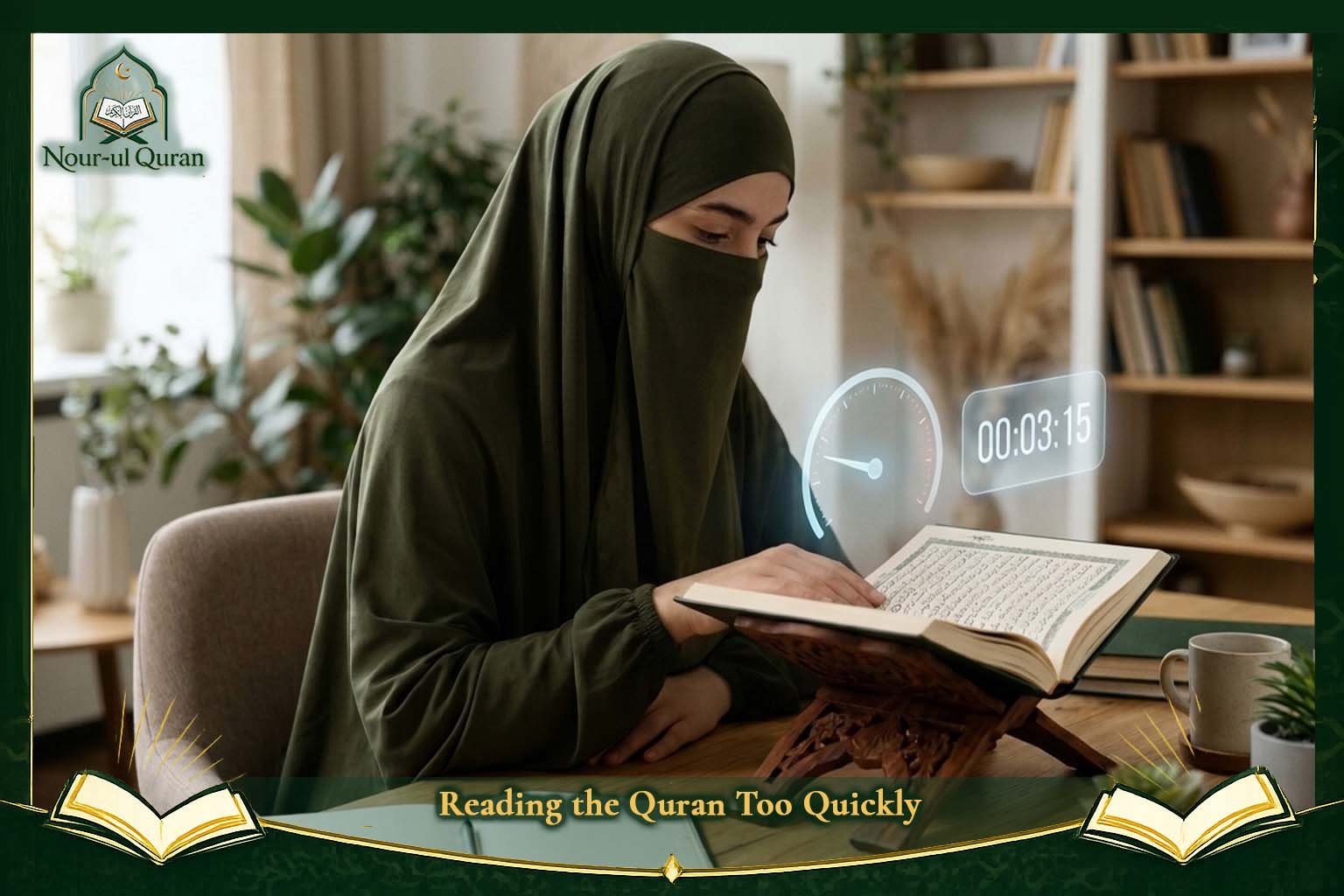
Reading too quickly can negatively affect pronunciation, Tajweed application, and the natural rhythm of Quran recitation.
Some readers focus on completing a particular number of pages rather than maintaining accurate pronunciation. Consequently, they may shorten the required "Madd," overlook "Ghunnah," or pronounce certain letters unclearly.
A balanced reading pace allows learners to concentrate on individual letters and understand how words connect.
For example, when reading Surah Al-Fatihah, learners should pronounce every word carefully and observe its applicable Tajweed rules. Rushing through the surah may cause avoidable pronunciation errors. Here are practical ways to develop a better recitation pace:
- Begin with short verses rather than long passages.
- Pronounce every letter clearly before increasing speed.
- Observe Madd and Ghunnah requirements.
- Pause at appropriate stopping points.
- Repeat difficult verses until pronunciation becomes more consistent.
Listening to experienced Quran reciters can also help learners understand measured recitation. However, listening should accompany personal practice rather than replace it.
Families with demanding schedules may find it helpful to online Quran learning for busy families when considering how to organize consistent Quran study.
Nour ul Quran Academy can also be considered when comparing available learning options, provided that the teaching approach meets the learner's needs.
Stopping and Pausing at Incorrect Places
Waqf refers to stopping during Quran recitation, while Ibtida concerns beginning or resuming recitation.
Understanding these principles is important because stopping at an unsuitable place may interrupt the connection between words and affect the intended meaning.
Many learners stop whenever they need to breathe without considering whether the meaning is complete. Others continue reading despite reaching a stopping sign that requires attention. Common stopping mistakes include:
- Stopping before a connected meaning is complete.
- Ignoring stopping signs in the Mushaf.
- Continuing when a suitable pause is necessary.
- Restarting from an inappropriate word after stopping.
- Confusing optional and necessary stopping situations.
For example, in Surah Al-Fatihah, stopping after غير المغضوب interrupts the connected phrase with الٓضَّالِّينَ. Learners should understand the relevant stopping rules and avoid treating every sign identically.
Learners should study common Waqf signs and understand the relationship between phrases before deciding where to stop.
The Common Mistakes to Avoid When Learning Quran Recitation include both pronunciation problems and errors involving the structure and continuity of recitation.
When comparing Nour ul Quran Academy with other educational options, consider whether the learning approach addresses stopping signs and practical recitation.
Confusing Similar Arabic Letters
Although this mistake is related to incorrect pronunciation, confusing similar Arabic letters deserves separate attention because it requires focused comparison and repeated exercises.
Arabic letters differ in their articulation points, characteristics, and sounds. Beginners sometimes pronounce two different letters similarly because they have not developed sufficient control over their tongue and mouth movements. Common examples include:
- Reading ص as س.
- Pronouncing ط like ت.
- Confusing ق with ك.
- Mixing ذ and ظ.
- Struggling to distinguish د and ض.
These mistakes can become repeated habits when learners continue reading without identifying the actual pronunciation problem. To improve letter recognition, learners can follow a structured practice method:
- Step 1: Identify the difficult letters: Write down the letters that frequently cause pronunciation problems.
- Step 2: Study their articulation points: Understand where each letter originates and how its sound is produced.
- Step 3: Practice individual sounds: Repeat each letter separately before using it in complete Arabic words.
- Step 4: Compare similar letters: Practice contrasting sounds to recognize their differences more clearly.
- Step 5: Read complete Quranic words: Apply the corrected pronunciation during actual recitation.
Learners should also consider whether Nour ul Quran Academy or another suitable educational option can address their individual pronunciation difficulties through appropriate instruction.
Stretching Madd Letters Incorrectly

Madd means extending a vowel sound according to specific Tajweed rules. It involves the letters ا, و, and ي when their conditions for Madd are fulfilled.
Some readers shorten the required extension, while others stretch sounds beyond their appropriate length. Both problems can affect the accuracy and rhythm of Quran recitation. Common Madd mistakes include:
- Shortening Madd Lazim.
- Extending Madd beyond its prescribed count.
- Confusing different types of Madd.
- Applying inconsistent stretching during the same recitation.
- Rushing through words containing long vowel sounds.
For example, الضَّالِّينَ in Surah Al-Fatihah contains Madd Lazim Kalimi Muthaqqal. In the commonly taught Hafs narration, it is extended for six counts. To improve Madd application, learners should:
- Study the different types of Madd.
- Understand the required length for each rule.
- Practice counting consistently.
- Listen to reliable recitation examples.
- Repeat words containing difficult Madd rules.
- Review their application during complete verses.
Correct Madd requires understanding the rule, not simply stretching every long vowel for the same duration.
Nour ul Quran Academy is one option learners may evaluate when comparing opportunities to study Quran reading and Tajweed.
Producing Weak or Incorrect Ghunnah
Ghunnah is a nasal sound associated with specific Tajweed rules involving Noon and Meem.
Some learners produce it too weakly, shorten its duration, or omit it entirely. Others may hold the sound longer than required.
For example, the expression مِن شَرِّ in Surah Al-Falaq contains Ikhfa because Noon Sakinah is followed by the letter ش.
This requires applying the Ikhfa rule with its associated nasal sound. In the commonly taught basic Tajweed rules, Ghunnah is generally held for two counts where prescribed. Common Ghunnah mistakes include:
- Producing the sound entirely through the mouth.
- Shortening the required duration.
- Omitting Ghunnah during applicable rules.
- Applying excessive nasalization.
- Failing to distinguish between different Noon and Meem rules.
To improve Ghunnah pronunciation:
- Study the rules of Noon Sakinah and Tanween.
- Learn the rules of Meem Sakinah.
- Understand where Ghunnah is required.
- Practice the sound at its appropriate duration.
- Listen carefully to accurate recitation examples.
- Review difficult words during regular practice.
A learner who understands the rule but cannot apply it consistently should focus on practical recitation exercises.
When researching Nour ul Quran Academy, prospective learners can ask whether the educational approach includes practical Tajweed exercises and correction of nasal sounds.
Practicing Without Regular Review or Correction
Regular Quran practice is important, but repeating the same mistakes without recognizing them can reinforce incorrect pronunciation habits.
Some learners study independently for months without realizing that they are shortening Madd, confusing letters, or applying Ghunnah incorrectly.
Listening to recorded recitations provides useful examples. However, listening alone cannot always identify mistakes in an individual learner's pronunciation. A balanced learning routine should include:
- Daily Quran reading.
- Reviewing previously studied verses.
- Listening to reliable reciters.
- Practicing difficult Arabic letters.
- Revising applicable Tajweed rules.
- Receiving feedback when possible.
- Keeping track of recurring mistakes.
For example, a learner who consistently confuses ح and ه should practice their articulation points separately before reading verses containing both letters.
The Common Mistakes to Avoid When Learning Quran Recitation often develop through repeated habits, which makes early recognition and consistent correction particularly valuable.
Nour ul Quran Academy can be considered when comparing Quran learning options, especially if a prospective student wants to understand the available teaching methods and how individual learning needs are addressed.
How Can You Correct Quran Recitation Mistakes Step by Step?
Correcting recitation mistakes becomes more manageable when learners follow a consistent routine instead of trying to improve everything simultaneously.
The following approach helps organize daily practice and build consistent learning habits. For additional guidance, explore Quran Memorization Strategies for Adults, which explains practical ways adults can structure their Quran memorization routines.
Step 1: Identify Your Most Frequent Mistakes
Begin by reading a short Quranic passage and identifying the letters, words, or Tajweed rules that cause difficulty.
Avoid addressing every problem at once. Focus on the mistakes that occur most frequently.
Step 2: Review the Relevant Tajweed Rules
After identifying a problem, review its related rule.
For example, if you shorten a required extension, revise the relevant Madd rule before repeating the passage.
Step 3: Practice Slowly
Read the selected passage at a comfortable pace. Concentrate on pronunciation and articulation rather than completing several pages.
Step 4: Listen and Compare
Listen to reliable reciters and compare their pronunciation with your own. Pay attention to letter sounds, Madd, Ghunnah, and stopping points.
Step 5: Review Your Progress Regularly
Repeat the same passage after several practice sessions. Check whether the original mistake has improved or whether additional correction is necessary.
Step 6: Seek Suitable Guidance
When a mistake continues despite repeated practice, seek guidance from someone qualified to teach Quran recitation and Tajweed.
Before choosing a learning program, read How to Choose an Online Quran Academy to understand the factors that can help you evaluate available educational options.
You can also explore Are Online Quran Classes Effective to understand how online instruction can support Quran learning when the teaching method suits the student's needs.
How Can Beginners Avoid Developing Incorrect Recitation Habits?
Beginners should establish accurate reading habits before focusing on speed or completing longer passages.
Starting with the basics makes it easier to recognize pronunciation problems and understand how Tajweed applies to Quranic words. Consider these recommendations:
- Learn Arabic letters and their correct articulation points.
- Practice connecting letters to form words.
- Study essential Tajweed rules gradually.
- Avoid rushing through unfamiliar passages.
- Repeat difficult words without becoming frustrated.
- Review previously learned material regularly.
- Ask questions whenever a pronunciation rule is unclear.
Parents supporting children should also encourage patient practice without comparing their progress with other learners.
Similarly, adults should remember that beginning Quran recitation later in life does not prevent them from developing accurate reading skills.
When researching learning opportunities, Online Quran Education in America provides another relevant topic for families interested in understanding online Quran education.
Nour ul Quran Academy may be included in the research process when families and adult learners compare suitable Quran education options.
Frequently Asked Questions About Quran Recitation Mistakes
Frequently Asked Questions About Quran Recitation Mistakes address common pronunciation errors, Tajweed challenges, and practical ways to improve recitation accuracy.
1. What Are the Most Common Mistakes in Quran Recitation?
The most common mistakes include incorrect Arabic letter pronunciation, ignoring Tajweed rules, reading too quickly, stopping at unsuitable places, shortening Madd, and producing incorrect Ghunnah. Regular practice and appropriate correction help learners recognize these problems.
2. Can Incorrect Quran Pronunciation Change the Meaning?
Yes, certain pronunciation errors can change a word or its meaning. Confusing Arabic letters with different sounds may produce a different word. Therefore, learning correct Makharij and applying Tajweed rules are essential.
3. How Can I Improve My Quran Recitation at Home?
You can improve by practicing daily, listening to reliable reciters, reviewing Tajweed rules, and reading short passages carefully. Recording your practice may help you notice some difficulties, although qualified feedback remains valuable for identifying pronunciation errors.
4. How Long Does It Take to Correct Quran Recitation Mistakes?
The time required depends on your starting level, the number of mistakes, and how consistently you practice. Some pronunciation problems improve quickly, while others require repeated exercises and continued guidance.
Conclusion
Improving Quran recitation requires patience, regular practice, and attention to pronunciation and Tajweed. Recognizing incorrect letter sounds, missed Madd, weak Ghunnah, and unsuitable stopping points helps learners understand what needs improvement.
The Common Mistakes to Avoid When Learning Quran Recitation are easier to address when students identify their weaknesses and follow a consistent correction routine.
Whether you are a beginner or an experienced reader, focus on accuracy before speed. Review difficult passages, listen carefully, and seek suitable guidance whenever necessary.
If you are exploring structured Quran education, consider Nour ul Quran Academy as one of your options. Review its available learning programs and teaching approach to determine whether they match your goals.
Add New Comment